Miami had an estimated 489,812 people on July 1, 2025, up 10.8% since the 2020 census and 22.6% since 2010. Florida's second-largest city.
Last checked Oct. 9, 2026. Sources: the U.S. Census Bureau’s Vintage 2025 city and town population estimates and county estimates, the 2010 and 2020 censuses, and the 2020-2024 American Community Survey 5-year estimates. Overview: QuickFacts for Miami.
The City of Miami had an estimated 489,812 residents on July 1, 2025, according to the U.S. Census Bureau. That makes it Florida’s second-largest city, behind Jacksonville (1,017,689) and ahead of Tampa (413,554) and Orlando (333,888). Miami holds about 17.5% of Miami-Dade County’s 2,802,029 people.
Miami in numbers
Miami Miami-Dade County Population, July 1, 2025 (estimate) 489,812 2,802,029 Population, 2020 census 442,241 2,701,767 Population, 2010 census 399,457 2,496,435 Growth, 2020 to 2025 +10.8% +3.7% Median age 39.3 40.7 Median household income $62,462 $71,753 Median home value (owner estimate) $518,100 $463,000 Age, income and home value: 2020-2024 American Community Survey.
Growth since 2010 and 2020
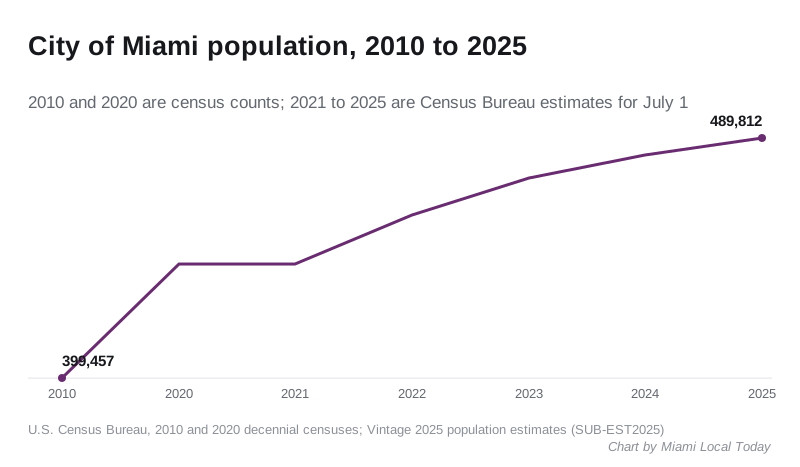
Miami grew 10.7% between the 2010 and 2020 censuses, from 399,457 to 442,241. Since 2020 it has grown faster still: the Bureau’s estimates add about 47,600 people in five years, a 10.8% rise, almost all of it from 2022 on.
| Year | Population | Source |
|---|---|---|
| 2010 | 399,457 | Census |
| 2020 | 442,241 | Census |
| 2021 | 442,275 | Estimate |
| 2022 | 460,762 | Estimate |
| 2023 | 474,744 | Estimate |
| 2024 | 483,419 | Estimate |
| 2025 | 489,812 | Estimate |
Over the same five years Miami-Dade County grew 3.7%, and the county’s estimate dipped slightly from 2024 to 2025 (2,812,144 to 2,802,029) while the city’s kept rising.
Who lives in Miami
From the Census Bureau’s 2020-2024 American Community Survey, which pools five years of responses:
- Age: the median age is 39.3. About 16.5% of residents are under 18 and 15.9% are 65 or older.
- Hispanic or Latino: 71.5% of residents (328,679 people), against 69.3% countywide.
- Born abroad: 57.7% of residents (265,248 people) were born outside the United States, against 54.5% in the county.
- Education: 37.4% of adults 25 and older hold a bachelor’s degree or higher; 34.4% countywide.
- Poverty: 19.4% of residents live below the poverty line, against 14.7% in the county.
Households, income and housing
- Households: 194,821, with an average of 2.32 people each (2.76 in the county).
- Renters: 69% of households rent (134,753) and 31% own (60,068). Countywide, 48% rent.
- Housing units: 223,826, of which 29,005 were vacant at survey time.
- Income: median household income $62,462; income per person $45,837, higher than the county’s $39,469.
- Rent and value: median gross rent $1,758 a month; median value of owner-occupied homes $518,100. For current prices, see Miami home prices.
Compared with the neighbors
Miami’s nearest incorporated neighbors, by the Bureau’s July 1, 2025 estimates:
| City | Distance from Miami | 2020 census | 2025 estimate | Change |
|---|---|---|---|---|
| Miami | 442,241 | 489,812 | +10.8% | |
| Miami Beach | about 5 miles | 82,890 | 81,594 | -1.6% |
| Miami Springs | about 6 miles | 13,859 | 13,611 | -1.8% |
| West Miami | about 6 miles | 7,233 | 7,125 | -1.5% |
| North Bay Village | about 6 miles | 8,159 | 8,099 | -0.7% |
Nearby unincorporated communities, which the Bureau counts in the census but does not estimate each year, had these 2020 census counts: West Little River 34,128; Coral Terrace 23,142; Brownsville 16,583; Gladeview 14,927.
Miami’s growth stands out: each neighboring city in the table had fewer people in 2025 than in 2020, by the Bureau’s estimates.
How to read these numbers
- Census counts (2010, 2020) are full counts. Estimates (2021 to 2025) are modeled each year from births, deaths and migration, and are revised.
- American Community Survey figures come from a sample and carry margins of error; the five-year version is the most reliable for a city.
- Data tables and margins of error are on data.census.gov.
Related: Miami home prices, Miami schools and moving to Miami.
Frequently asked questions
What is the population of Miami, Florida?
489,812, the Census Bureau’s estimate for July 1, 2025. The 2020 census counted 442,241 people in the City of Miami.
Is Miami growing?
Yes. The city added about 47,600 people from the 2020 census to mid-2025, a 10.8% rise, while Miami-Dade County as a whole grew 3.7%.
Is Miami the largest city in Florida?
No. By the Census Bureau’s 2025 estimates, Jacksonville (1,017,689) is the largest and Miami (489,812) is second, ahead of Tampa and Orlando.
What is the median household income in Miami?
$62,462, according to the Census Bureau’s 2020-2024 American Community Survey, against $71,753 for Miami-Dade County.
How many people in Miami rent?
About 69% of households, or 134,753 of 194,821, rented their home in the 2020-2024 American Community Survey.
Have your say