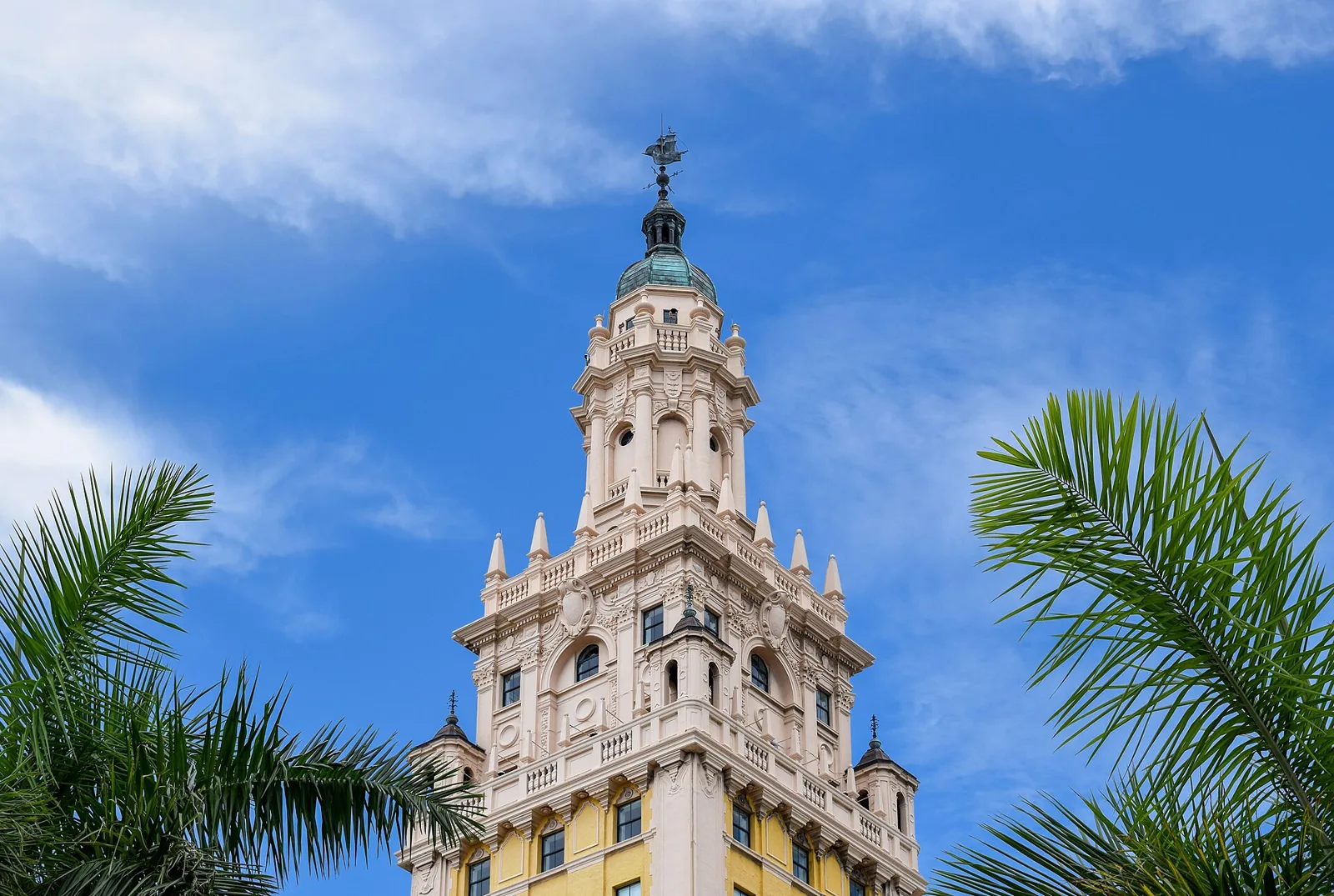
Miami was incorporated July 28, 1896, months after the first train arrived. 68 National Register listings stand in the city, from Vizcaya to the Freedom Tower.
Last checked Oct. 9, 2026. Sources: the Florida Department of State’s historical marker “Julia Tuttle: Mother of Miami” (erected 2020) and the National Park Service’s National Register of Historic Places listed properties file, listings through May 22, 2026. Addresses were matched to the city limits with the Census Bureau geocoder.
Miami became a city in 1896, the same year the railroad arrived on Biscayne Bay. Today 68 National Register of Historic Places listings stand inside the city limits, from downtown office towers and churches to Coconut Grove houses and the seaplane terminal that is now City Hall.
Visit
- Vizcaya Museum and Gardens: 3251 S. Miami Ave.; events and tickets at vizcaya.org
- The Museum of Miami (the county’s history museum): 305-375-1305, museumofmiami.org
- City of Miami Cemetery: 1800 NE Second Ave., listed on the National Register in 1989
- Historic Virginia Key Beach Park: 4020 Virginia Beach Drive, 305-960-4600
How Miami began
From the state historical marker for Julia Tuttle, “Mother of Miami,” erected in 2020:
- Tuttle came from Cleveland, Ohio, in 1891 and bought 644 acres that included Fort Dallas.
- After the freezes of 1894 and 1895, she sent orange blossoms and oranges to the railroad builder Henry Flagler to persuade him to bring his Florida East Coast Railway south to Biscayne Bay. In return she gave him land for a terminal, a hotel and future city blocks.
- “It is the dream of my life to see this wilderness turned into a prosperous country,” she said.
- The first train arrived April 13, 1896, and the city was incorporated July 28, 1896.
- Tuttle died at 49 on Sept. 14, 1898.
Historic districts
The National Park Service lists seven districts inside the city:
- Downtown Miami Historic District (2005), roughly bounded by Miami Court, Third Street, Third Avenue and Second Street.
- Lummus Park Historic District (2006), roughly bounded by NW Second Street, NW Third Court, NW Fourth Street and NW North River Drive.
- South River Drive Historic District (1987), six buildings on SW First and Second streets and SW South River Drive.
- Bay Shore Historic District (1992), between NE 55th and NE 60th streets, Biscayne Boulevard and the bay.
- Grove Park Historic District (2023), off NW 17th Avenue near SR 836.
- Vizcaya, the James Deering estate (1970, expanded 1978).
Landmarks of national significance
Four Miami listings are also National Historic Landmarks, the federal government’s highest designation:
- Vizcaya, 3251 S. Miami Ave. (landmark 1994)
- The Freedom Tower, 600 Biscayne Blvd. (landmark 2008); the Park Service file lists its significance as Hispanic heritage, architecture, communications and social history.
- The Miami Circle at Brickell Point, 401 Brickell Ave. (landmark 2009)
- The Marjory Stoneman Douglas House, 3744 Stewart Ave., Coconut Grove (landmark 2015)
Every National Register listing in the city
These 68 listings have addresses that fall inside the City of Miami. The year is when each was added to the register.
| Listed | Property | Address |
|---|---|---|
| 1970 | Vizcaya (National Historic Landmark, 1994) | 3251 S. Miami Ave. |
| 1973 | Ralph M. Munroe House (The Barnacle) | 3485 Main Highway |
| 1973 | Ransom School “Pagoda” | 3575 Main Highway |
| 1974 | El Jardin | 3747 Main Highway |
| 1974 | Gesu Church | 118 NE Second St. |
| 1974 | Miami Women’s Club | 1737 N. Bayshore Drive |
| 1974 | Plymouth Congregational Church | 3429 Devon Road |
| 1975 | Dr. James M. Jackson Office | 190 SE 12th Terrace |
| 1975 | First Coconut Grove School | 3429 Devon Road |
| 1975 | Pan American Seaplane Base and Terminal Building | 3500 Pan American Drive |
| 1975 | Women’s Club of Coconut Grove | 2985 S. Bayshore Drive |
| 1978 | Vizcaya (Boundary Increase) | Roughly bounded by South Dixie Highway, SW 32nd Road, and S. Miami Ave. |
| 1979 | Freedom Tower (National Historic Landmark, 2008) | 600 Biscayne Blvd. |
| 1979 | Miami City Hospital, Building No. 1 | 1611 NW 12th Ave. |
| 1980 | Trinity Episcopal Cathedral | 464 NE 16th St. |
| 1983 | J. W. Warner House | 111 SW Fifth Ave. |
| 1983 | U.S. Post Office and Courthouse | 300 NE First Ave. |
| 1984 | Fire Station No. 4 | 1000 S. Miami Ave. |
| 1984 | Olympia Theater and Office Building | 174 E. Flagler St. |
| 1985 | Congress Building | 111 NE Second Ave. |
| 1986 | Miami Edison Senior High School | 6101 NW Second Ave. |
| 1987 | South River Drive Historic District | 428, 438 SW First St., 437 SW Second St., 104, 109, 118 SW South River Drive |
| 1988 | Atlantic Gas Station | 668 NW Fifth St. |
| 1988 | Mount Zion Baptist Church | 301 NW Ninth St. |
| 1989 | Alfred I. DuPont Building | 169 E. Flagler St. |
| 1989 | Brickell Mausoleum | 501 Brickell Ave. |
| 1989 | Central Baptist Church | 500 NE First Ave. |
| 1989 | City National Bank Building | 121 SE First St. |
| 1989 | City of Miami Cemetery | 1800 NE Second Ave. |
| 1989 | D. A. Dorsey House | 250 NW Ninth St. |
| 1989 | Dade County Courthouse | 73 W. Flagler St. |
| 1989 | Fire Station No. 2 | 1401 N. Miami Ave. |
| 1989 | Hahn Building | 140 NE First Ave. |
| 1989 | Huntington Building | 168 SE First St. |
| 1989 | Ingraham Building | 25 SE Second Ave. |
| 1989 | Kentucky Home | 1221 and 1227 NE First Ave. |
| 1989 | Lyric Theater | 819 NW Second Ave. |
| 1989 | Martina Apartments | 1023 S. Miami Ave. |
| 1989 | Meyer-Kiser Building | 139 NE First St. |
| 1989 | Old U.S. Post Office and Courthouse | 100-118 NE First Ave. |
| 1989 | Palm Cottage | 60 SE Fourth St. |
| 1989 | S and S Sandwich Shop | 1757 NE Second St. |
| 1989 | Security Building | 117 NE First Ave. |
| 1989 | Shoreland Arcade | 120 NE First St. |
| 1989 | Southside School | 45 SW 13th St. |
| 1989 | Walgreen Drug Store | 200 E. Flagler St. |
| 1990 | Miami Senior High School | 2450 SW First St. |
| 1992 | Bay Shore Historic District | Roughly bounded by NE 55th St., Biscayne Blvd., NE 60th St. and Biscayne Bay |
| 1992 | Greater Bethel AME Church | 245 NW Eighth St. |
| 1992 | St. John’s Baptist Church | 1328 NW Third Ave. |
| 1994 | Trapp Homestead | 2521 S. Bayshore Drive |
| 1995 | Barracks and Mess Building, U.S. Coast Guard Air Station at Dinner Key | 2610 Tigertail Ave. |
| 1997 | Sears, Roebuck and Company Department Store | 1300 Biscayne Blvd. |
| 2002 | The Miami Circle at Brickell Point Site (National Historic Landmark, 2009) | 401 Brickell Ave. |
| 2002 | U.S. Coast Guard Air Station Hangar at Dinner Key | 2600 S. Bayshore Drive |
| 2005 | Downtown Miami Historic District | Roughly bounded by Miami Court, Third St., Third Ave., and Second St. |
| 2006 | Lummus Park Historic District | Roughly bounded by NW Second St., NW Third Court, NW Fourth St., and NW North River Drive |
| 2012 | William Jennings Bryan House | 3115 Brickell Ave. |
| 2014 | Vagabond Motel | 7301 Biscayne Blvd. |
| 2015 | Marjory Stoneman Douglas House (National Historic Landmark, 2015) | 3744 Stewart Ave. |
| 2016 | Ace Theatre | 3664 Grand Ave. |
| 2017 | Coconut Grove Library | 2875 McFarlane Road |
| 2018 | Bacardi Complex | 2100 Biscayne Blvd. |
| 2018 | Coconut Grove Playhouse | 3500 Main Highway |
| 2020 | Miami Black Police Precinct and Courthouse | 480 NW 11th St. |
| 2023 | Flori-Coral Apartments | 1250 SW Sixth St. |
| 2023 | Grove Park Historic District | Bounded by NW 17th Ave., SR 836, NW 14th Court, and NW Seventh St. |
| 2026 | Masjid al-Ansar | 5245 NW Seventh Ave. |
Five more listings with Miami addresses could not be placed inside the city by the geocoder or have a restricted address: Virginia Key Beach Park (2002), the Miami Marine Stadium on the Rickenbacker Causeway (2018), Halissee Hall at 1700 NW 10th Ave. (1974) and the Kampong in Coconut Grove (1984, address restricted). The Venetian Causeway (1989) links Miami with Miami Beach. Other listings with a Miami mailing address, such as the Hampton House Motel (2022) and Lincoln Memorial Park Cemetery (2018), are in unincorporated Brownsville, outside the city limits.
Black history landmarks
The Park Service file lists Black history among the reasons for significance of the D. A. Dorsey House (1989), the Ace Theatre in Coconut Grove (2016), the Miami Black Police Precinct and Courthouse (2020), Masjid al-Ansar (2026) and Virginia Key Beach Park (2002). The beach, once “colored-only,” passed from the county to the city in 1982, its trust says.
What this means for you
- Downtown’s Flagler Street is lined with register buildings: the Dade County Courthouse, the Olympia Theater, the Alfred I. DuPont Building and the Walgreen Drug Store.
- Coconut Grove’s Main Highway holds The Barnacle, the Ransom School “Pagoda,” El Jardin and the Coconut Grove Playhouse.
- City Hall itself, the former Pan American seaplane terminal, is on the register.
Related: parks and trails, things to do this month and Miami population and growth.
Frequently asked questions
When was Miami founded?
The City of Miami was incorporated on July 28, 1896, a few months after the first Florida East Coast Railway train arrived on April 13, 1896, according to the state historical marker for Julia Tuttle.
Who founded Miami?
Julia Tuttle, called the Mother of Miami on her state historical marker, persuaded Henry Flagler to extend his railroad to Biscayne Bay after the freezes of 1894 and 1895, and gave him land for a terminal, a hotel and city blocks.
How many National Register historic places are in Miami?
68 National Register listings sit at addresses inside the City of Miami, by our count of the National Park Service’s May 2026 file, from Vizcaya (1970) to Masjid al-Ansar (2026). Four are also National Historic Landmarks.
What are Miami’s National Historic Landmarks?
Vizcaya (designated 1994), the Freedom Tower (2008), the Miami Circle at Brickell Point (2009) and the Marjory Stoneman Douglas House in Coconut Grove (2015).
Is Miami City Hall historic?
Yes. City Hall at 3500 Pan American Drive is the former Pan American Seaplane Base and Terminal Building, listed on the National Register in 1975.
Have your say