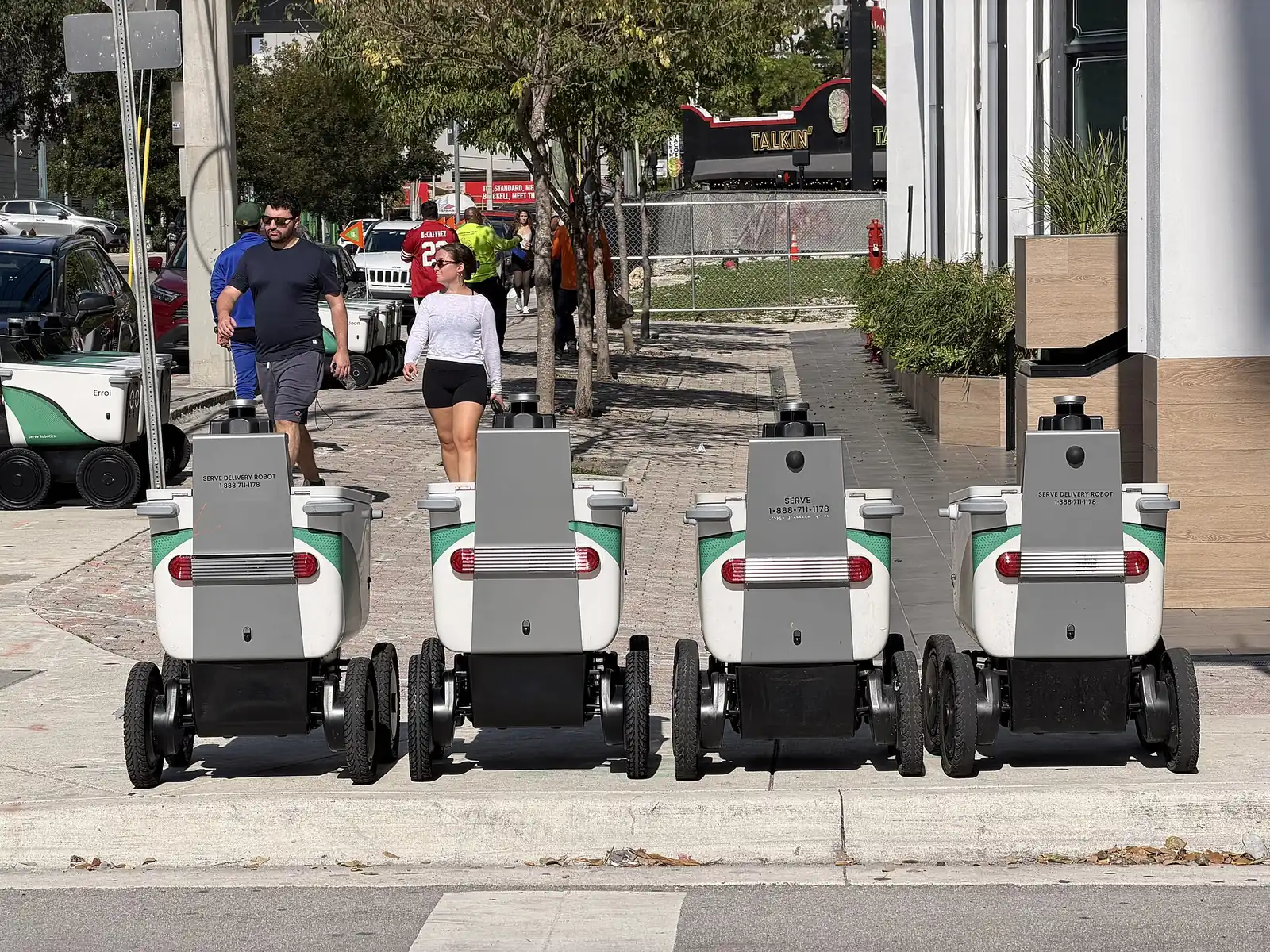
Sidewalk delivery robots in Miami-Dade would need a permit and keep to 8 mph under a county ordinance up for a final vote Tuesday. Fines would start at $250.
The robots that roll food orders along Miami sidewalks would need a permit, keep to 8 mph and stay out of school zones under a Miami-Dade County ordinance up for a final vote Tuesday, Nov. 17.
The Miami-Dade Board of County Commissioners has the ordinance on its Nov. 17 agenda as item 7(C), a public hearing on second reading. Commissioner Micky Steinberg is the prime sponsor. The county’s Transportation Committee sent it to the full board with a favorable recommendation on Oct. 14, after amending it.
What the ordinance would require
The ordinance creates a “Personal Delivery Device and Mobile Carrier Safety Code” in the county code. The amended text sets these rules for every delivery robot:
- Speed: no more than 8 mph on sidewalks, 6 mph in high-pedestrian areas the county designates and 10 mph in crosswalks
- Crosswalks: a full stop before entering one, and pedestrians get the right of way at all times
- School zones: no operating during the hours the school zone speed limit is enforced
- Idling: no parking or idling on a sidewalk for more than 30 minutes unless making a delivery, and never in a crosswalk or on the textured warning pads at curb ramps
- Clear paths: no blocking crosswalks, curb ramps, fire hydrants, transit stops or bus loading spots
- Equipment: white front and red rear lights, reflectors, an audible alert that carries 15 feet, obstacle detection, an automatic stop if the robot loses its signal and a QR code linking to the operator’s contact details
- Breakdowns: operators must remove a broken robot from the sidewalk within six hours and report any crash causing injury or damage within 24 hours
Operators would also need at least $100,000 in liability insurance, the minimum state law already sets.
The county’s Department of Transportation and Public Works could go further. The text lets it name high-pedestrian areas, set slow-speed and time-of-day zones, and cap how many robots run under each permit. Those limits may not amount to a ban in any zone.
Fines and permits
A robot operating without a permit, or without the required insurance, would draw a $500 civil penalty. Any other violation would cost $250 for a first offense and $500 after that. Each day a violation continues counts as a separate offense.
The ordinance sets no permit fee. The county would set fees later by administrative order.
What changed in committee
Steinberg’s original version set a 10-minute idling limit. Her substitute raised it to 20 minutes. At the Oct. 14 hearing, a lobbyist for Serve Robotics asked for 30 minutes, and the committee agreed, the county’s legislative record shows. The committee also let the county set aside zones where robots may wait longer.
Advertising drew the longest debate. The substitute banned ads on the robots apart from the owner’s name. The committee changed that so ads are allowed under a separate agreement between the county and an operator, approved by the full board. Steinberg told the committee that some robots in the city of Miami were advertising gambling, and said she would prefer no advertising at all.
The record also notes that Steinberg said robots were “causing significant problems in many areas.” Vice Chairwoman Raquel Regalado said they were common in her district and that many restaurants prefer them to human couriers.
Who would enforce it in the city of Miami
The ordinance covers both the cities and unincorporated Miami-Dade. Each city may enforce it or write its own rules, stricter or looser. Robots in a city would get their permits from that city. The county keeps the power to enforce its rules inside any city that has not adopted its own.
The mayor’s office estimated the county would need two enforcement officers and a clerk, at about $251,773 a year in salary and benefits. The fiscal impact statement warns that permit fees may not cover that cost, because only a few companies operate or test the robots in the county.
If the board adopts it, the ordinance takes effect 10 days later unless the mayor vetoes it. The mayor’s office must report back to the board on how it is working one year after that.
What it means for you
- If a robot blocks your sidewalk or curb ramp, the new rules would make that a violation. Every robot would carry a QR code or phone number for its operator.
- If you want to speak, the Nov. 17 item is a public hearing, so residents can address the board before it votes.
- If you run a restaurant that uses robot delivery, expect the operators you work with to need a city or county permit and to keep robots out of school zones at drop-off and pickup times.
Have your say